
Platform Overview
Precise ratings.
Automated process.
Reduced risk.
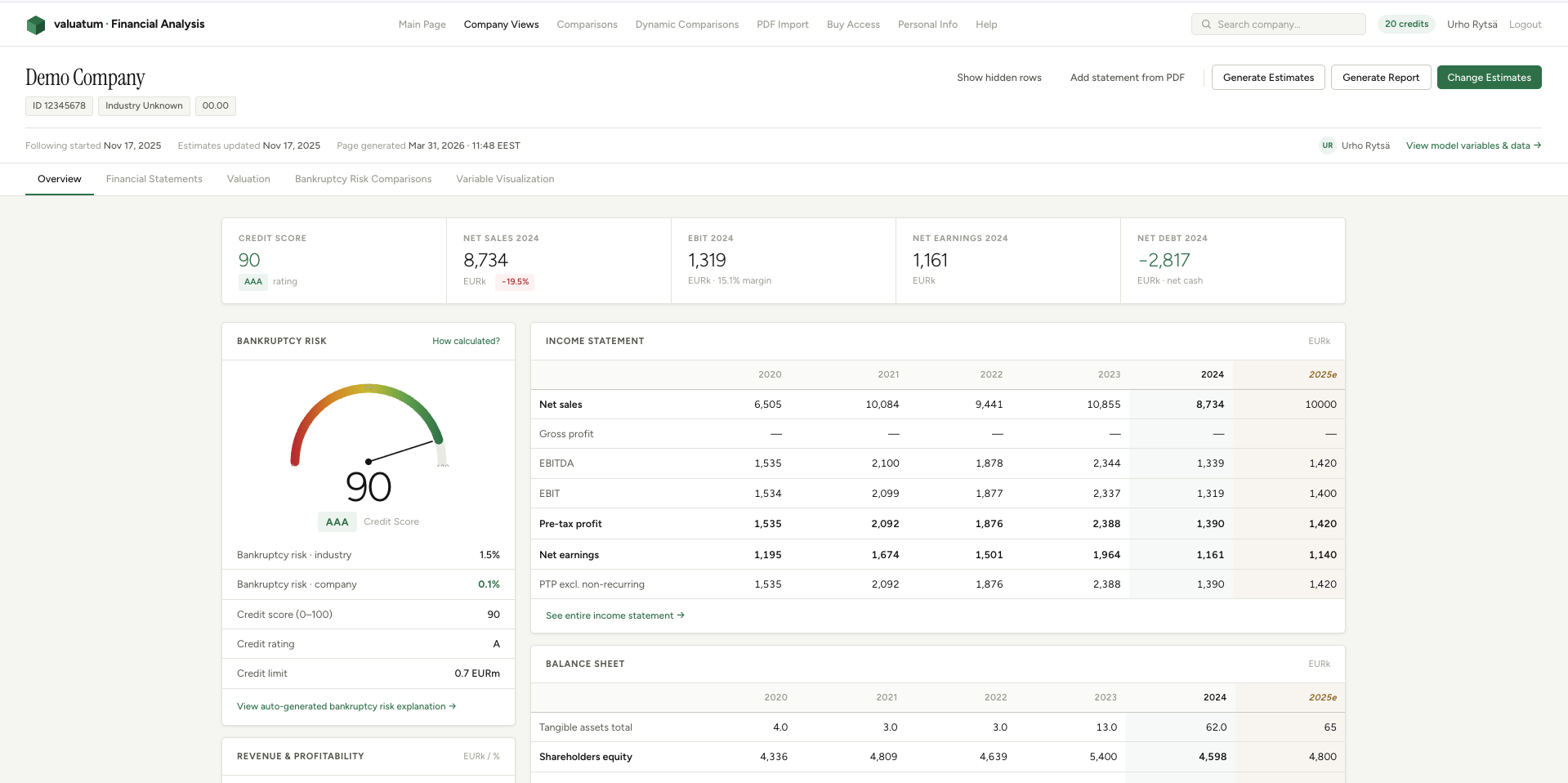
Valuatum's SaaS credit risk platform automates the most time-consuming parts of the credit rating process. Built on advanced machine-learning algorithms, our models dynamically weight financial ratios to fit each individual case — delivering more accurate risk assessments than any fixed-weight approach can provide.
From initial application to investor reporting, Valuatum creates value across the entire credit supply chain.
Key Capabilities
Everything the credit process needs.
Speed Up Credit Applications
Receive pre-rated credit applications and reports ready for further analysis. Improve average application quality and generate automatic reports at scale.
State-of-the-Art Bankruptcy Models
Advanced machine-learning algorithms that adapt to situations where traditional models fail. No more missed opportunities or decisions based on misleading data.
Versatile Analysis Platform
Access and edit your data via web browser, Excel models, or APIs. The platform can be tailored to your exact needs, with access to audited financial data on nearly 200,000 Finnish companies.
Automated Reporting
Pre-filled tables and graphs with customizable layouts. One-click PDF and Word report generation. Standardized credit reports ready to distribute.
Company Views & Comparisons
Visualize company financials with customizable views, future estimates, and scenario building. Peer group analysis with versatile selections across hundreds of variables.
Excel Integration
Edit financial data effortlessly within Excel. A user-friendly interface with automatic features and support for custom sheets that fit your existing workflows.
The Valuatum Difference
Why machine learning outperforms traditional models.
- Most time-consuming tasks performed manually by the lender
- Inaccurate, outdated models using fixed financial ratio weights
- Fails to account for individual company characteristics
- Places all companies into the same mold regardless of context
- Leads to over- or under-estimation of bankruptcy risk in edge cases
- Potentially costly missed opportunities or risky decisions
- Most time-consuming tasks are automated
- Advanced models that dynamically weight financial ratios per case
- Takes into account the unique nature of each company
- Selects the most suitable ratios and adjusts weights to fit each scenario
- Accurate bankruptcy risk estimation for every individual case
- Efficient, defensible credit decisions with clear audit trail
Real-World Examples
Where traditional models fall short.
These examples illustrate how fixed-weight models can lead to costly mistakes — and how Valuatum's machine-learning approach correctly identifies what matters in each individual case.
Company Profile
Company A is relatively stable with high profitability and a sound financial position. Because they can access credit easily, they have no need to maintain high liquidity buffers.
Traditional Model Failure
Fixed-weight models over-emphasize liquidity, causing the model to assign an artificially high bankruptcy risk — and a worse credit rating than reality warrants. The lender may miss a good low-risk opportunity, and Company A pays an interest rate higher than it deserves.
Valuatum Result
Valuatum's machine-learning model recognizes that liquidity is less critical for companies like Company A. It correctly concentrates on other financial figures, assigns an accurate rating, and allows the lender to capitalize on a genuine low-risk opportunity.
Company Profile
Company B has poor profitability, is generating heavy losses, carries high debt, and has no financial buffer to absorb setbacks.
Traditional Model Failure
Fixed-weight models under-estimate the importance of liquidity in this context, making Company B appear more creditworthy than it is. A lender using traditional methods may take on undue risk based on an inaccurate rating.
Valuatum Result
Valuatum's model understands that liquidity risk increases significantly for companies in Company B's situation. It weights this appropriately, assigns a correct rating, and ensures the lender can evaluate the true risk — and price it accordingly.
Company Profile
Company C is highly profitable with low indebtedness — on paper, a solid low-risk company. On closer inspection, it has an extremely high receivables turnover time and a balance sheet dominated almost entirely by sales receivables.
Traditional Model Failure
Fixed-weight models assign a good rating based on profitability and low debt, paying little attention to the underlying receivables problem. The lender proceeds with an investment based on an inaccurate picture of the company's health.
Valuatum Result
Valuatum's algorithm flags the high receivables turnover as a potential indicator of financial distress, despite the seemingly strong headline figures. The lender is alerted to investigate further — and may correctly avoid a high-risk exposure.
See the platform in action.
Access the demo version of our Credit Risk platform to explore Company Views, Comparisons, and our Bankruptcy Risk Model — no commitment required.
Questions? Reach us at contact25@valuatum.com or +358 45 123 0308